
Free. No signup. Step-by-step
Proportion Calculator
Find the missing value in any proportion. Get the answer and step-by-step solution in seconds.
Leave one box empty. That is the value you want to find.
The Proportion Calculator helps you find the missing value in any equal-ratio problem instantly. Whether you’re checking homework, scaling a recipe, or working through a word problem, our proportions solver makes your calculation simple.
It also shows the exact steps, so you can see how the answer was found, not just what it is. Before using the Calc, let’s first understand what a proportion is.
What Is a Proportion?
A proportion states that two ratios are equal. A ratio compares two numbers, such as 2 to 5. When two ratios represent the same relationship, they form a proportion. For example, 2/5 = 4/10 is a proportion because both fractions describe an identical relationship between their parts.
Proportions follow one core rule: multiplying or dividing both numbers in a ratio by the same value keeps the ratio equal. This is what allows numbers to scale up or down while keeping their relationship intact.
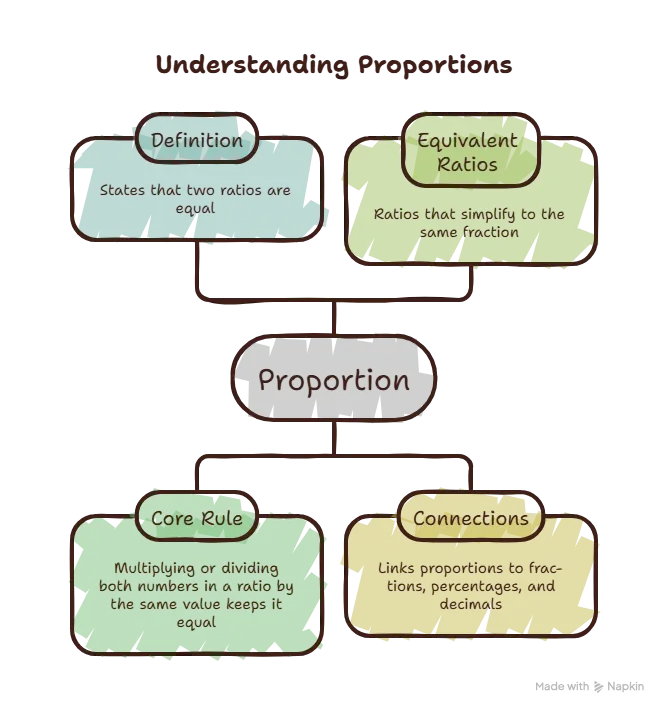
Equivalent ratios are the building blocks of every proportion. Two ratios are equivalent when they simplify to the same fraction. 3:6 and 1:2 are equivalent ratios because both reduce to the same value. It is simply a mathematical statement confirming that two ratios are equivalent.
Proportions connect closely to fractions, percentages, and decimals. A ratio can be written as a fraction (3/4), converted to a decimal (0.75), or expressed as a percent (75%). Recognizing these connections helps you move between formats when solving real problems, like converting a recipe ratio into a percentage of total ingredients.
For additional learning resources on ratios and proportions, students can explore Cuemath.
👉 Try the Proportion Calculator now; enter your three known values above and get an instant, step-by-step answer.
Proportion formula and cross multiplication
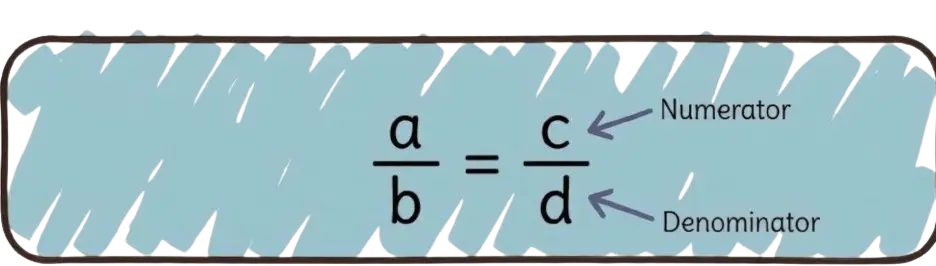
Every proportion follows this structure:
a / b = c / d
The equation is called a proportional statement because it shows that two ratios are equal.
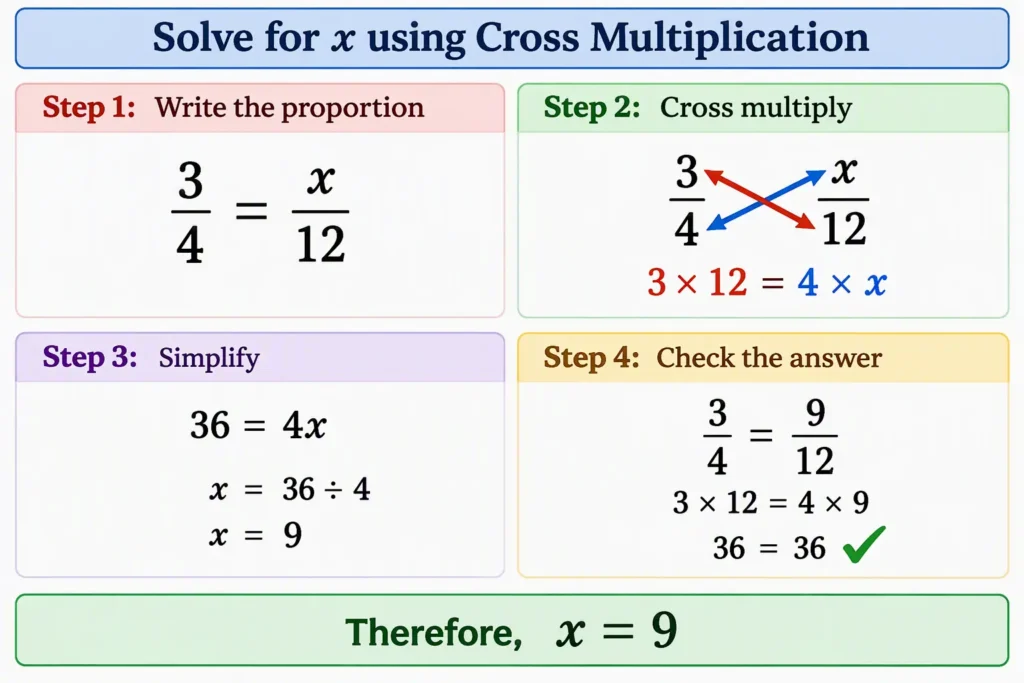
To solve for a missing value, apply cross multiplication:
a × d = b × c
If “d” is unknown, rearrange the formula:
d = (b × c) / a

This method works regardless of which value is missing. You always multiply the two numbers diagonally opposite the unknown, then divide by the remaining number.
Means and Extremes
In the proportion a/b = c/d, the numbers have specific names:
Extremes: the first and last numbers (a and d)
Means: the two middle numbers (b and c)
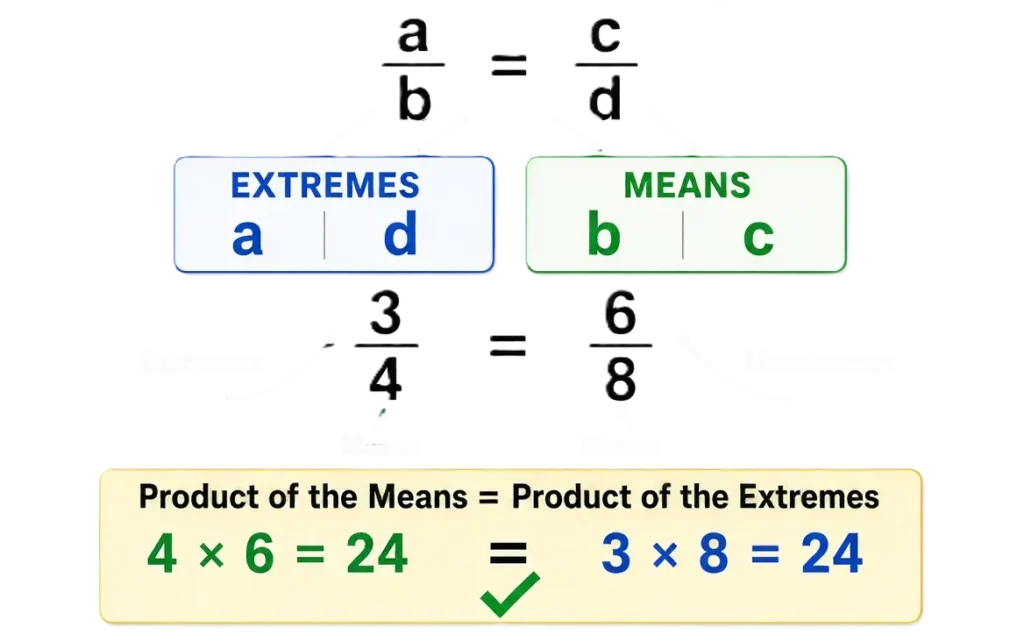
In 3/4 = 6/8, the extremes are 3 and 8, and the means are 4 and 6. A key property of proportions states that the product of the means equals the product of the extremes: 4 × 6 = 24, and 3 × 8 = 24. This is exactly what cross multiplication calculates.
Skip the manual math—let the proportion calculator apply the cross product property for you and show the full working instantly.
How Does a Proportion Calculator Work?
The calculator takes three known numbers from a proportion and helps you find out the fourth value quickly and accurately.
You enter values in this format: A / B = C / x
It applies the cross product property automatically, isolates the unknown, and returns the exact result along with the steps used to reach it. This makes it useful both for getting a fast answer and for checking hand-written homework against a reliable second source.
You can also use our Proportion Calculator for both numerical proportions and basic algebraic equations involving variables.
How to Use a Proportion Calculator
Enter the three known values. | The proportion calculator will automatically solve for the missing term and display the step-by-step solution. |
Click calculate | The calculator applies cross multiplication to solve for the missing value. |
Review the result and steps | Compare the shown working against your own reasoning to confirm accuracy. |
How to Solve Proportions Manually
Direct vs. Inverse Proportion
Not every proportional relationship behaves the same way. Quantities can be directly or inversely proportional, and knowing the difference matters for evaluating word problems correctly.
Direct Proportion
Two quantities are directly proportional when they increase or decrease together at a constant rate. If one value doubles, the other doubles too.
Formula: y = kx, where k is a constant.
| Hours Worked | Pay earned |
|---|---|
| 1 | $15 |
| 2 | $30 |
| 3 | $45 |
| 4 | $60 |
As hours increase, pay increases at the same rate. This is a direct proportion, with k = 15.
Real-world example: The more gallons of gas you buy, the more you pay. Cost and quantity rise together at a fixed rate per gallon.
Inverse Proportion
Two quantities are inversely proportional when one increases as the other decreases, keeping their product constant.
Formula: y = k/x, where k is a constant.
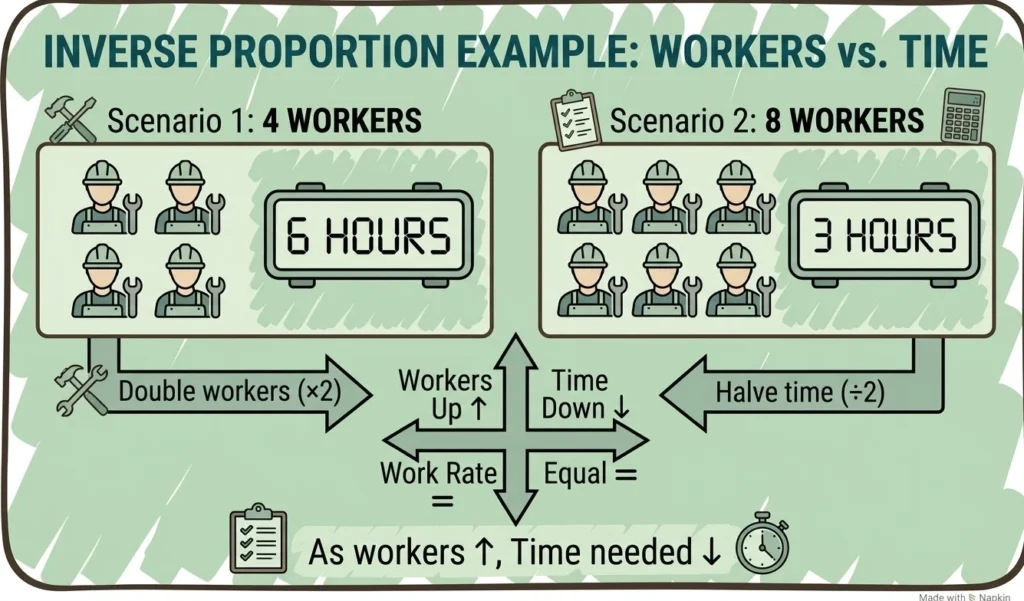
Real-world example: Speed and travel time are inversely proportional for a fixed distance. Driving faster reduces the time needed to arrive.
Constant of Proportionality
The constant of proportionality (k) is the fixed number that relates two proportional quantities. In a direct proportion (y = kx), k tells you how much y changes for every one-unit change in x.
Example: If a car travels 300 miles in 5 hours at a constant speed, the constant of proportionality is
k = 300 ÷ 5 = 60 (miles per hour)
This single number, the unit rate, lets you predict any other value in the relationship. Drive for 8 hours at that same rate, and you’d travel 60 × 8 = 480 miles. You can verify this instantly with the proportion calculator above.
Worked examples
Proportions Solve for X
2/3 = x/9
2 × 9 = 3 × x → 18 = 3x → x = 6
Comparing prices
3 apples cost $1.50. How much do 8 apples cost?
3/1.50 = 8/x → 3x = 12 → x = $4.00
These examples show just the basics, but proportions help with many daily tasks. Discover the complete breakdown of how this math works in the real world: Real-Life Examples of Proportions You Use Every Day.
Real-World Uses
Proportions solve practical problems across nearly every field:
Cooking and baking | Scaling ingredients up or down while keeping taste and texture consistent. |
Maps and scale models | Converting a map scale, like 1 inch to 10 miles, into real-world distances. |
Blueprints and construction | Engineers and architects use scale proportion when creating blueprints, maps, and technical drawings. |
Currency conversion | Using an exchange rate as a constant of proportionality to compute values between different currencies. |
Speed, distance, and time | Calculating how far you’ll travel at a constant speed, or how long a trip will take. |
Density and concentration | Comparing mass to volume, or determining the strength of a mixture at different amounts. |
Tax calculations | Applying a tax rate consistently across different purchase amounts. |
Shopping discounts | Finding the sale price of an item based on a percentage discount. |
Business and profit sharing | Splitting profits or costs between partners according to their investment ratio. |
Medicine dosages | Calculating medication amounts based on body weight. |
Each case relies on the same underlying math. Only the numbers and context change.
Got a similar situation? Plug your own numbers into the proportion calculator above and check your answer against the steps shown.
Proportions in Geometry
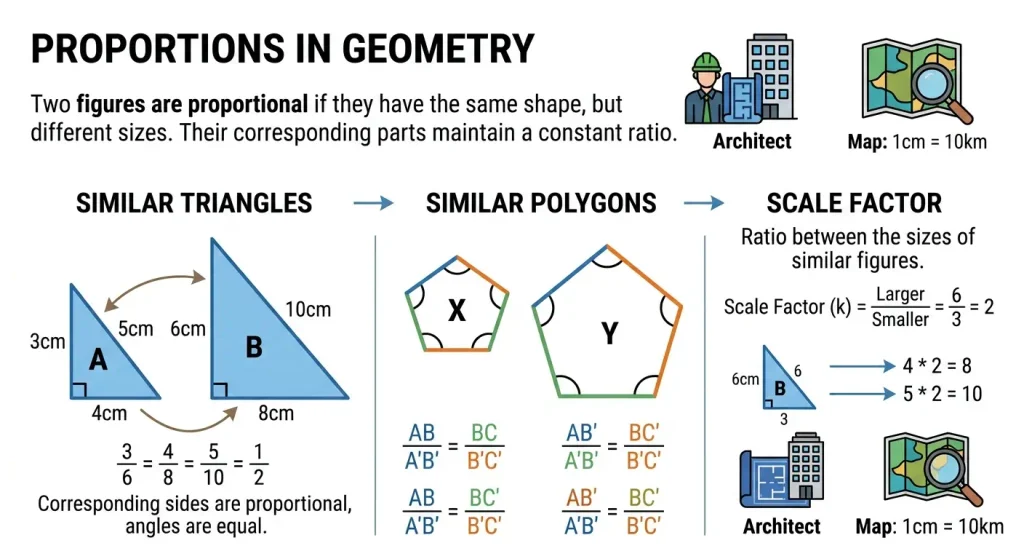
Proportions play a central role in geometry, especially when comparing shapes of different sizes. Similar triangles have the same shape but not necessarily the same size. Their corresponding sides are proportional, and their corresponding angles are equal.
If two triangles are similar, you can set up a proportion between matching sides to find a missing length. This method is also commonly used in right triangle problems involving similar triangles. Similar polygons follow the same rule: all corresponding sides share the same ratio, and all corresponding angles are equal.
A scale factor is the ratio between the sizes of two similar figures. A scale factor of 2 means every side of the new figure is twice as long as the original. Architects use scale factors to shrink buildings onto blueprints, and mapmakers use them to shrink real distances onto paper.
Example: Triangle A has sides 3, 4, and 5. Triangle B is similar, with a shortest side of 6. The scale factor is 6/3 = 2, so Triangle B’s other sides are 8 and 10.
The Golden Ratio
The golden ratio is a special proportion, approximately 1.618, often represented by the Greek letter phi (φ). Two quantities are in the golden ratio when the ratio of the larger to the smaller equals the ratio of their sum to the larger.
Artists, architects, and designers have used this ratio for centuries because it’s associated with visually balanced proportions. It appears in classical architecture, Renaissance paintings, and modern logo design. It also shows up in nature, in patterns like spiral shells and the arrangement of leaves and seeds in some plants.
While not every proportion involves this ratio, it’s a well-known example of how proportional relationships extend beyond arithmetic into art and design.
For a deeper look at the mathematical and historical significance of the golden ratio, see the Encyclopaedia Britannica article on the Golden Ratio.
Common Mistakes
Setting up the ratio in the wrong order. Both sides of the proportion must compare the same units in the same order.
Skipping the verification step. Always plug your answer back into the original proportion to confirm both sides are equal.
Forgetting units. Track what each number represents, not just its numeric value.
Cross multiplying incorrectly. Multiply diagonally, not straight across. Multiplying the two numerators together is a common error.
Avoid these errors automatically — let the Proportion calculator do the cross multiplication and verification for you.
Rounding too early. Wait until the final step to round decimal answers, so accuracy isn’t lost along the way.
Confusing direct and inverse proportion. Assuming a relationship is direct when it’s actually inverse leads to the wrong setup and a wrong answer.
Frequently asked questions
Conclusion
Proportions turn everyday comparisons into solvable math. Once you understand cross multiplication, means and extremes, and the difference between direct and inverse proportion, you can solve nearly any proportional problem, from recipe scaling to geometry to business math.
Use the Proportion Calculator above for a fast, verified answer, and work out the missing value in seconds. Whether you need to solve proportions, check equivalent ratios, understand ratio and proportion relationships, or perform a quick proportion calculation, the tool provides accurate results along with step-by-step explanations.
Got a proportion to solve?
Get the awnser and every steps in seconds