Real-Life Examples of Proportions You Use Every Day
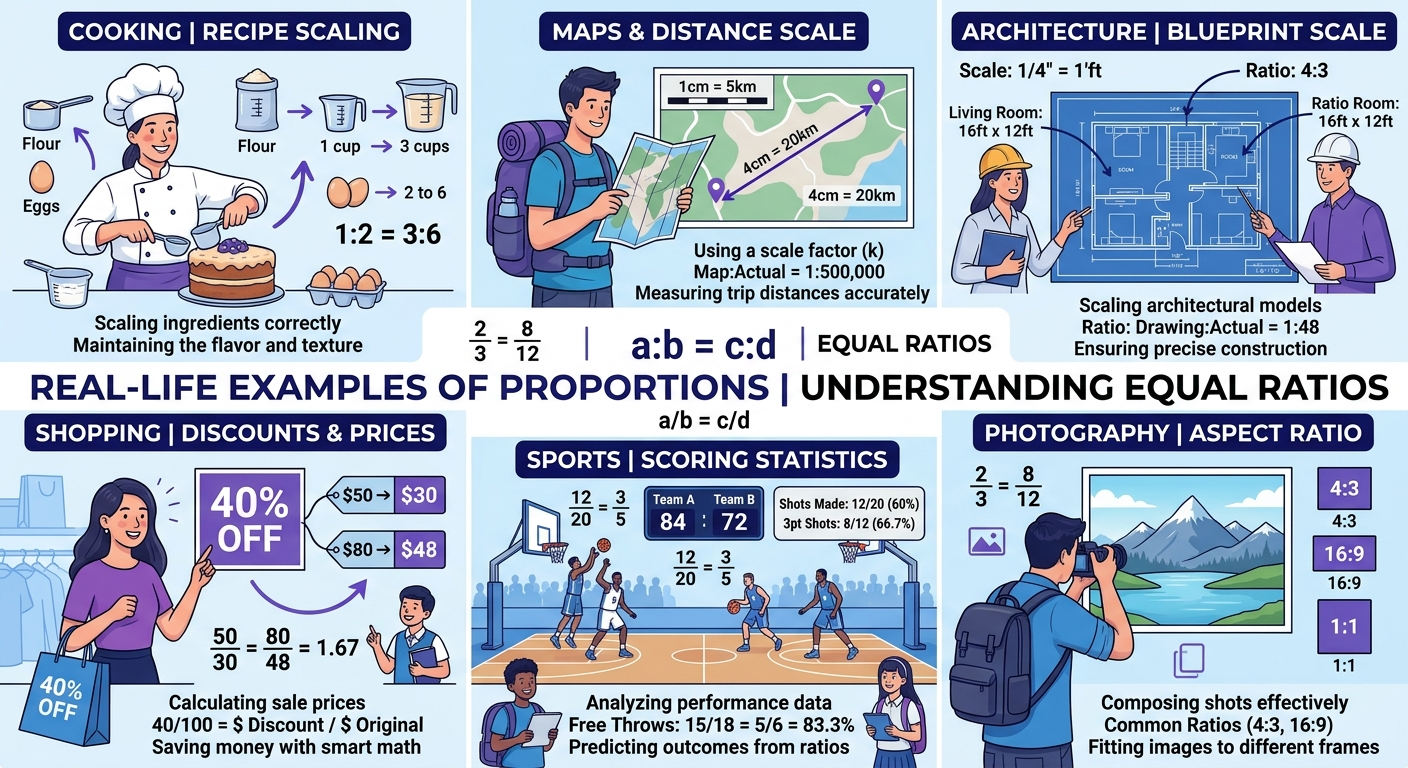
You use math all day, even when you don’t notice it. You double a recipe for guests. You check a map to see how far a trip will take. You compare two prices at the store. Each time, you use a proportion.
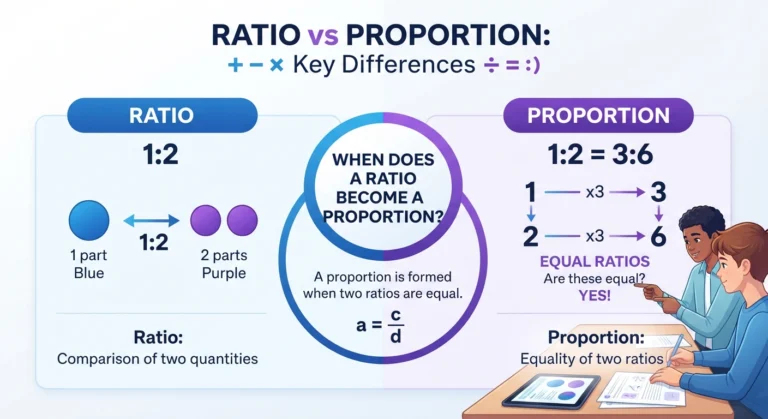
A proportion says that two ratios are equal. For example, 2 out of 4 is the same as 5 out of 10. Both equal one half. Once you know three numbers, you can find the fourth. That one skill solves a huge range of problems.
This guide gives you 15 real-life examples of proportions, each with a short story, a worked calculation, and a quick reason it matters. Students, teachers, parents, and working professionals can all use them. You can check any answer with our free Proportion Calculator.
How Proportions Work in 3 Simple Steps
Every example below follows the same pattern. Learn it once and you can solve them all.
- Write two equal ratios. Put the unknown number in the spot marked x.
- Cross-multiply. Multiply the top of one ratio by the bottom of the other.
- Divide. Divide by the remaining number to find x.
If 2 apples cost $3, how much do 6 apples cost?
Six apples cost $9.
Not sure two ratios match? Use the Check Equality mode in our Proportion Calculator. Enter all four numbers, and it tells you if you have a true proportion.
Proportions in Cooking
Recipes list amounts for a set number of servings. When your guest list changes, every ingredient must change by the same factor. If you only change some of them, the dish tastes wrong.
A pancake recipe serves 4 people and needs 3 cups of flour. How much flour do you need for 10 people?
4x = 30
x = 7.5 cups
Proportions in Medicine
Many medicines use a dose based on body weight. Nurses and pharmacists also use proportions to mix liquids and prepare the right strength. Small errors can cause harm, so accuracy is critical.
A drug label says the dose is 5 mg for every 10 kg of body weight. What dose fits a child who weighs 24 kg?
10x = 120
x = 12 mg
Proportions in Construction
Builders mix concrete, mortar, and plaster using fixed ratios. A mix with too little cement turns weak. A mix with too much wastes money and can crack.
A mortar mix uses 1 part cement to 4 parts sand. You plan to use 20 buckets of sand. How many buckets of cement do you need?
4x = 20
x = 5 buckets
Proportions in Architecture
Architects draw plans at a smaller size than the real building. A scale such as 1:50 means 1 unit on paper equals 50 units in real life. Every wall, door, and window follows the same scale.
A wall measures 8 cm on a 1:50 plan. How long is the real wall?
x = 400 cm = 4 m
| Plan scale | 1 cm on paper equals |
|---|---|
| 1:20 | 20 cm |
| 1:50 | 50 cm |
| 1:100 | 1 m |
Proportions on Maps
Every map has a scale that links paper distance to ground distance. Hikers, drivers, and pilots use it to plan time and fuel.
A map scale says 1 cm = 5 km. Two towns sit 7.5 cm apart on the map. How far apart are they?
x = 37.5 km
Proportions in Photography
Photos have an aspect ratio, which compares width to height. A common ratio is 3:2. If you resize an image and break that ratio, the picture looks stretched or squashed.
You want a 3:2 photo that is 1,800 pixels wide. How tall should it be?
3x = 3600
x = 1,200 pixels
| Format | Aspect ratio | Common use |
|---|---|---|
| Standard photo | 3:2 | Cameras, prints |
| Widescreen | 16:9 | Video, screens |
| Portrait post | 4:5 | Social media |
Proportions in Finance
Money math is full of proportions. Currency exchange, interest, tax, and budgeting all compare one amount to another.
Suppose the sample rate is $1 = €0.90. How many euros do you get for $250?
x = 250 × 0.90
x = €225
Proportions in Sports
Coaches and fans track success rates: goals per shot, runs per game, points per minute. Proportions turn a small sample into a prediction.
A player makes 18 of 24 free throws. At the same rate, how many will she make in 40 attempts?
24x = 720
x = 30 shots
Proportions in Shopping Discounts
A percent is a ratio out of 100. That makes every sale a proportion problem.
A jacket costs $80 and the store takes 25% off. How much do you save?
100x = 2000
x = $20 saved
Sale price: $80 − $20 = $60
Proportions in Fuel Consumption
Fuel use grows in a steady line with distance. Drivers use that fact to plan trips and budgets.
A car uses 8 liters of fuel for every 100 km. How much fuel does a 350 km trip need?
100x = 2800
x = 28 liters
Proportions in Classroom Math
Teachers use proportions to teach ratios, rates, percentages, and similar shapes. Most proportion word problems follow the same plan: find the two quantities, write the ratios, then solve.
5 pens cost $7.50. How much do 12 pens cost?
5x = 90
x = $18
Proportions in Engineering
Engineers use proportions for scale models, gear ratios, pipe flow, and material strength. A small test often predicts how a large system will behave.
A pump fills 600 liters in 15 minutes. How long will it take to fill a 2,000-liter tank?
600x = 30,000
x = 50 minutes
Proportions in Fashion Design
Designers scale patterns to fit different sizes and plan how much fabric to buy. Sketches also follow body proportions so clothes hang well.
3 dresses need 7.5 meters of fabric. How much fabric do you need for 10 dresses?
3x = 75
x = 25 meters
Proportions in Population Studies
Researchers cannot ask every person a question. They survey a sample, then use a proportion to estimate the result for the whole group.
In a sample of 500 people, 120 prefer taking the bus. A city has 250,000 people. About how many prefer the bus?
500x = 30,000,000
x = 60,000 people
Proportions in Chemistry Mixtures
A solution has a set amount of one substance in a set amount of liquid. Labs, hospitals, and even pool owners use these ratios to get the right strength.
A salt solution uses 5 g of salt in 100 mL of water. How much salt do you need for 350 mL?
100x = 1750
x = 17.5 g
All 15 Proportions at a Glance
| Area | Ratio used | Answer |
|---|---|---|
| Cooking | 3 cups : 4 servings | 7.5 cups for 10 |
| Medicine | 5 mg : 10 kg | 12 mg for 24 kg |
| Construction | 1 cement : 4 sand | 5 buckets for 20 |
| Architecture | 1 : 50 scale | 4 m wall |
| Maps | 1 cm : 5 km | 37.5 km |
| Photography | 3 : 2 aspect | 1,200 px tall |
| Finance | $1 : €0.90 | €225 |
| Sports | 18 : 24 shots | 30 of 40 |
| Discounts | 25 : 100 | $20 saved |
| Fuel | 8 L : 100 km | 28 L |
| Classroom | 5 pens : $7.50 | $18 for 12 |
| Engineering | 600 L : 15 min | 50 minutes |
| Fashion | 3 dresses : 7.5 m | 25 m for 10 |
| Population | 120 : 500 | 60,000 people |
| Chemistry | 5 g : 100 mL | 17.5 g for 350 mL |
Proportion Examples and Math Problems With Answers
The 15 stories above show where proportions appear. Now you can build the skill itself. This section gives you ratios and proportions examples, proportions math problems examples, and a short practice set. Try each problem first, then check your work.
From Ratio to Proportion: Examples
A ratio compares two numbers, such as 2:5. It becomes a proportion when you set it equal to another ratio. To build one, multiply or divide both parts of the ratio by the same number.
Start with the ratio 2:5. Multiply both parts by 3.
Check: 2 × 15 = 30 and 5 × 6 = 30
The cross products match, so 2/5 = 6/15 is a true proportion.
Proportion Equation Examples
The unknown can sit in any of the four spots. The method stays the same: cross-multiply, then divide.
| Equation | Cross-multiply | Answer |
|---|---|---|
| x / 8 = 3 / 4 | 4x = 24 | x = 6 |
| 5 / x = 15 / 9 | 15x = 45 | x = 3 |
| 7 / 12 = 21 / x | 7x = 252 | x = 36 |
| 2.5 / 10 = x / 16 | 10x = 40 | x = 4 |
Solving Proportions: Step-by-Step Examples
These examples of solving proportions show the full process, including one with an expression in place of a single letter.
Solve 6 / 9 = 10 / x.
6x = 90
x = 15
Solve (x + 2) / 5 = 6 / 10.
10(x + 2) = 30
x + 2 = 3
x = 1
Proportional Equation Example: y = kx
Two quantities are proportional when one always equals the other times the same number. That number is the constant of proportionality, written k. The equation looks like y = kx.
A taxi charges $3 for each kilometer. The cost y equals 3 times the distance x.
When x = 4, y = 3 × 4 = 12
The next table lists proportional ratios examples. Each pair has the same value of k, so the ratios are equal.
| Distance (x) | Cost (y) | y / x |
|---|---|---|
| 1 km | $3 | 3 |
| 2 km | $6 | 3 |
| 4 km | $12 | 3 |
| 7 km | $21 | 3 |
Ratio and Proportion Examples With Answers: Practice Set
Solve these five problems on paper. Tap each one to see the answer and the work.
1. Paint: 2 cans cover 30 m². How much do 5 cans cover?
2. Class ratio: The boy-to-girl ratio is 3:5. There are 24 boys. How many girls are there?
3. Walking: You walk 6 km in 90 minutes. How long will 10 km take at the same pace?
4. True or false: Is 4/6 = 10/15?
Both match, so it is a true proportion.
5. Scale model: A model car uses a 1:24 scale. The model is 18 cm long. How long is the real car?
Common Mistakes When Solving Proportions
- Mixing up units. Putting hours on top in one ratio and minutes on top in the other gives a wrong answer. Keep units in the same place.
- Flipping one ratio. If you write 3/4 = 10/x, the second ratio must also put servings on the bottom. Check every pair.
- Adding instead of multiplying. If a recipe grows from 4 to 8 servings, you multiply every ingredient by 2. You do not add 4 to each.
- Using the wrong type of relationship. Some links run opposite ways. More workers finish a job faster, so time shrinks as workers grow. That is an inverse proportion and needs a different setup.
- Forgetting to simplify. Reduce ratios first. 18/24 becomes 3/4, and the numbers get easier.
- Skipping the sense check. If 10 pens cost less than 5 pens, something went wrong. Ask whether the answer makes sense.
Benefits of Learning Proportions
- Faster decisions. You compare deals, doses, and distances in seconds.
- Better grades. Proportions feed into algebra, geometry, physics, and chemistry.
- Money savings. You spot the best price and avoid waste.
- Career skills. Nurses, builders, designers, analysts, and chefs all rely on them.
- Stronger logic. You learn to break a problem into parts and test the result.
Frequently Asked Questions
What are real-life examples of proportions?
Scaling a recipe, finding a medicine dose by weight, reading a map scale, resizing a photo, working out a sale price, and mixing a solution are all common cases. Any time two ratios stay equal, you use a proportion.
How are proportions used in cooking?
Cooks use them to scale recipes up or down. If 3 cups of flour serve 4 people, then 10 people need 7.5 cups.
Why are proportions important in medicine?
Doctors and nurses match doses to a patient’s weight and prepare liquids at the right strength. Accurate ratios help keep patients safe.
What is a simple proportion example?
If 5 pens cost $7.50, then 12 pens cost $18. Write 5/7.50 = 12/x, cross-multiply, and divide.
Can proportions be used in business?
Yes. Businesses use them to set prices, convert currency, plan inventory, split costs, and predict sales from a small sample.
Conclusion
These real-life examples of proportions show how often one simple idea solves daily problems. You scale a recipe, read a map, spot a bargain, or check a dose with the same three steps: write two equal ratios, cross-multiply, and divide.
Practice with the examples above, then try your own numbers. Start small, keep your units in the right spots, and check that each answer makes sense. With a little repeat use, proportions start to feel natural.
Solve Your Own Proportion in Seconds
Enter three numbers and get the fourth, with the steps shown.
Use the Proportion CalculatorUse Solve for X to find a missing value, or Check Equality to test if two ratios match.