Ratio vs Proportion: What’s the Difference?
Ratios and proportions look alike, so many students mix them up. Both use the same numbers. Both can appear in the same word problem. Yet they do different jobs.
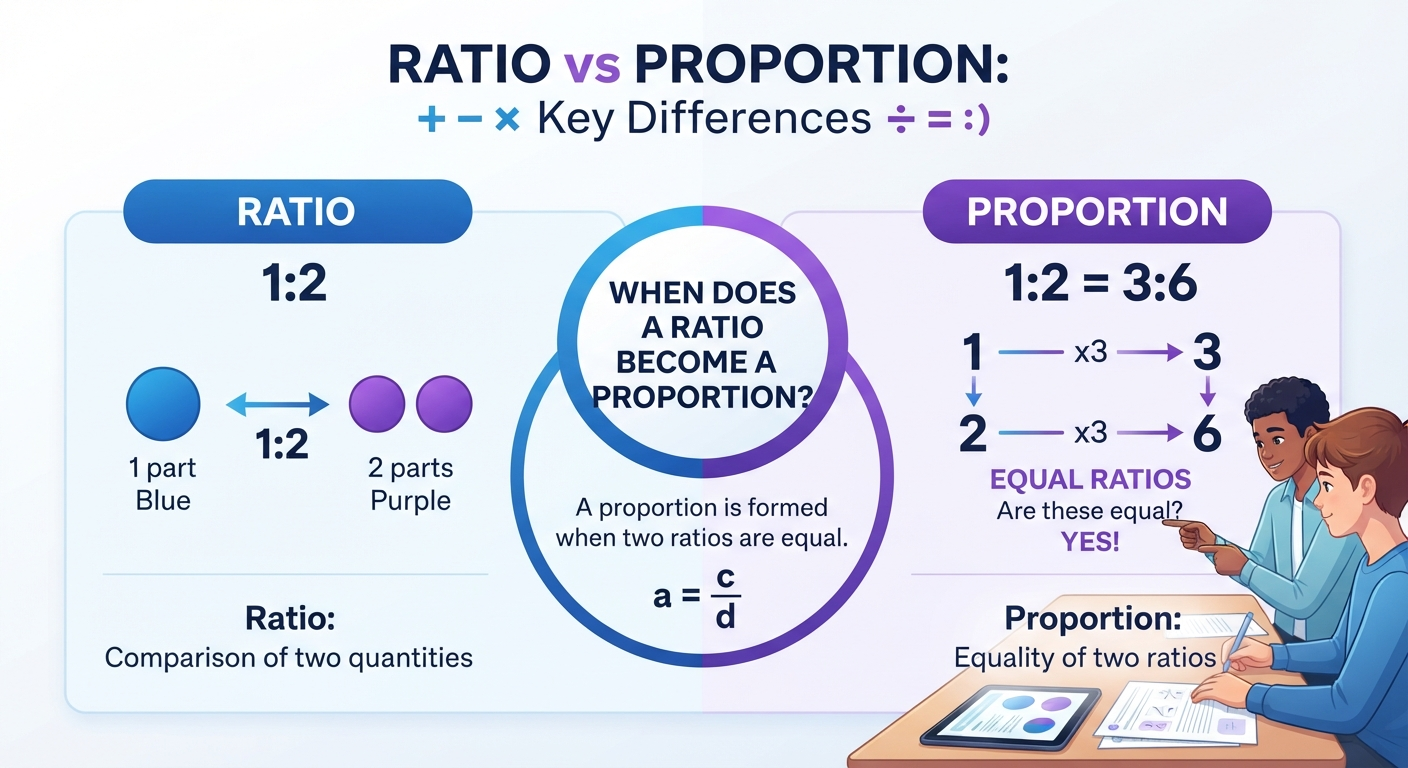
A ratio compares two quantities. A proportion says that two ratios are equal. That one sentence explains the difference between ratio and proportion. The rest of this guide shows you how it works, with tables, examples, and practice questions.
If you ask “what is ratio and proportion?”, think of a comparison and a match. The comparison is the ratio. The match is the proportion. By the end, you will know which one a problem uses, and you can use a Proportion Calculator to check your work.
What Is a Ratio?
Definition
A ratio is a way to compare two quantities by division. It tells you how much of one thing you have compared with another. This mathematical comparison can involve objects, money, time, or distance.
Say a bag holds 3 red marbles and 5 blue marbles. The ratio of red to blue is 3 to 5.
Ratio Formula
You can write a ratio in three ways. All three mean the same thing.
| Style | How it looks | How you read it |
|---|---|---|
| Colon | a : b | a to b |
| Fraction | a / b | a over b |
| Words | a to b | a to b |
The Core Rule
Order matters. The ratio 3:5 is not the same as 5:3.
Simple Ratio Examples
These ratio examples show the three most common types.
| Type | What it compares | Example |
|---|---|---|
| Part to part | One group to another group | 3 red marbles : 5 blue marbles = 3:5 |
| Part to whole | One group to the total | 3 red out of 8 marbles = 3:8 |
| Rate | Two different units | 60 km in 1 hour = 60:1 |
How to simplify a ratio
Divide both terms by the same number. For 12:18, divide each term by 6.
Example
12 : 18 → 12 ÷ 6 : 18 ÷ 6 = 2 : 3
The ratios 12:18 and 2:3 are equivalent ratios. They show the same ratio relationship in smaller numbers.
Real-Life Ratio Examples
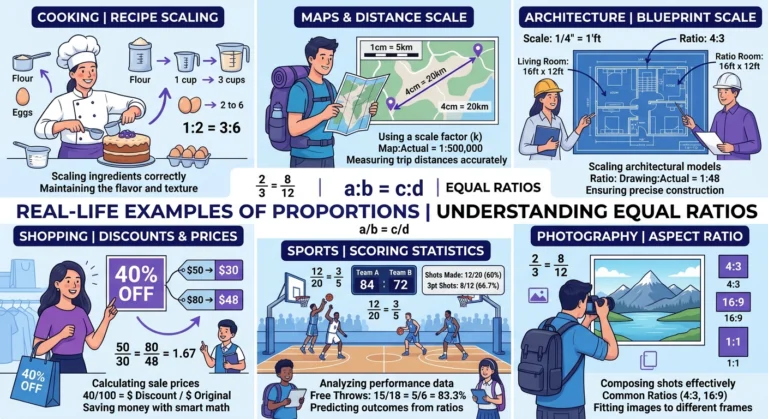
- Cooking: 1 cup of rice to 2 cups of water.
- Paint: 2 parts blue to 1 part white.
- School: 1 teacher for every 25 students.
- Screens: a 16:9 video shape.
- Sports: 24 points in 8 games.
When Does a Ratio Become a Proportion?
A ratio becomes a proportion when it is set equal to another equivalent ratio. For example, 1:2 becomes a proportion when written as 1:2 = 3:6 because both ratios represent the same relationship. For a complete explanation, see our What Is Proportion? guide.
For example, 1:2 and 3:6 both describe the same comparison. So you can write 1/2 = 3/6. That statement is a proportion.
Proportion Formula
The Core Rule
Check it with cross multiplication: a × d = b × c.
If the two cross products match, the proportion is true. If they do not match, the ratios are not equal.
Equivalent Ratios
Equivalent ratios are ratios that name the same relationship. You make them by multiplying or dividing both terms by the same number.
| Start | Multiply by | Equal ratio |
|---|---|---|
| 1 : 2 | 2 | 2 : 4 |
| 1 : 2 | 3 | 3 : 6 |
| 1 : 2 | 10 | 10 : 20 |
Each pair of equal ratios in that table forms a proportion. Every equal ratio you make adds a new proportion to the list.
Real-Life Proportion Examples
Two notebooks cost $6. How much do five notebooks cost? You set two ratios equal and solve.
Example
2 / 6 = 5 / x → 2x = 30 → x = 15
Five notebooks cost $15.
Do you want to solve proportions faster? Our proportion solver shows each step. This guide focuses on how ratios and proportions differ, so we keep the solving steps short.
Ratio vs Proportion at a Glance
This table gives you proportion vs ratio explained in one view. Use it as a fast check before you start a problem.
| Feature | Ratio | Proportion |
|---|---|---|
| Definition | A comparison of two quantities | A statement that two ratios are equal |
| Purpose | Shows how much of one thing there is compared with another | Shows that two comparisons match, or finds a missing value |
| Format | a : b, a / b, or a to b | a : b = c : d or a / b = c / d |
| Example | 3 : 5 | 3 / 5 = 6 / 10 |
| Uses | Comparing, simplifying, describing | Scaling, predicting, solving for unknowns |
| Application | Mixing paint, reading a scale, comparing groups | Resizing a recipe, converting units, planning a trip |
| Equation | Not an equation. It has no equals sign. | An equation with an equals sign |
| Relationship | The building block | Made from two ratios |
Key Differences Between Ratio and Proportion
The ratio and proportion difference shows up in seven places. Read each one slowly.
1. A ratio compares. A proportion matches.
A ratio looks at two quantities and tells you how they relate. A proportion looks at two ratios and tells you they are the same. One is a measurement of a relationship. The other is a claim about two relationships.
2. A ratio has two terms. A proportion has four.
The ratio 2:3 has two terms. The proportion 2:3 = 4:6 has four terms. Ratio compared to proportion is therefore the smaller, simpler idea.
3. A proportion has an equals sign. A ratio does not.
A ratio stands alone, such as 7:2. A proportion links two ratios with “=”. If you see an equals sign between two ratios, you are looking at a proportion.
4. A ratio is simplified. A proportion is solved.
With a ratio, you usually simplify it or write it another way. With a proportion, you often solve for a missing term, as in 3/4 = x/20.
5. A proportion can be true or false. A ratio cannot.
A ratio has no truth value. It just describes. A proportion makes a claim, and you can test it. The statement 2/3 = 4/6 is true. The statement 2/3 = 4/7 is false.
| Statement | Cross products | Result |
|---|---|---|
| 2 / 3 = 4 / 6 | 2 × 6 = 12 and 3 × 4 = 12 | True proportion |
| 2 / 3 = 4 / 7 | 2 × 7 = 14 and 3 × 4 = 12 | Not a proportion |
6. A ratio can use different units. A proportion keeps them matched.
A ratio can compare dollars to apples, such as $2 for 3 apples. In a proportion, the same kinds of units must sit in the same position on both sides. Dollars go on top on the left, so dollars go on top on the right.
7. A ratio is a number or relationship. A proportion is a relationship between relationships.
You can turn a ratio into one number. The ratio 6:3 equals 2. A proportion does not become one number. It stays a statement about two ratios.
Quick Check
Relationship Between Ratio and Proportion
Proportions do not exist without ratios. A proportion is two ratios joined by an equals sign. The ratio is the part. The proportion is the whole statement.
Diagram 1: How a ratio becomes a proportion
| Step 1 | Step 2 | Step 3 | Step 4 |
|---|---|---|---|
| Start with a ratio | Make an equal ratio | Join them with = | Check the cross products |
| 3 : 4 | Multiply both terms by 2 → 6 : 8 | 3 : 4 = 6 : 8 | 3 × 8 = 24 and 4 × 6 = 24 |
Diagram 2: The parts of a proportion
| Ratio | Link | Ratio |
|---|---|---|
| 3 : 4 | = | 6 : 8 |
| First ratio | equals | Second ratio |
Read the two diagrams together. A ratio like 3:4 is a single comparison. When you find another ratio that matches it, you create a proportional relationship between the two.
Proportional relationship in one line
Two quantities have a proportional relationship when their ratio always stays the same. If one cup of rice needs two cups of water, then two cups of rice need four cups of water. The ratio never changes. That steady ratio is what makes the relationship proportional.
The Link in Plain Words
Proportion = two equal ratios.
Need a missing number? Use the equal ratios to find a missing value in a proportion, or check it with our Proportion Calculator.
Ratio vs Proportion Examples
These ten examples cover areas of daily life. Each row shows a ratio first. Then it uses a proportion to answer a new question.
| Area | Ratio (the comparison) | Proportion (the match and the answer) |
|---|---|---|
| 1. Students | 12 boys and 18 girls → 12:18 = 2:3 | Another class has 20 boys in the same ratio. 2/3 = 20/x, so x = 30 girls |
| 2. Sports | 24 points in 8 games → 24:8 = 3:1 | Same rate for 20 games. 24/8 = x/20, so x = 60 points |
| 3. Money | Save $150 from $600 income → 150:600 = 1:4 | Income is $900. 1/4 = x/900, so x = $225 saved |
| 4. Shopping | 3 apples for $2 → 3:2 | Cost of 12 apples. 3/2 = 12/x, so x = $8 |
| 5. Recipes | 2 cups rice to 5 cups water → 2:5 | Use 6 cups rice. 2/5 = 6/x, so x = 15 cups water |
| 6. Maps | Map scale 1 : 50,000 | A 4 cm gap on the map. 1/50,000 = 4/x, so x = 200,000 cm = 2 km |
| 7. Business | 5 sales per 100 visitors → 5:100 = 1:20 | 2,400 visitors. 5/100 = x/2,400, so x = 120 sales |
| 8. Classroom | 1 teacher for 25 students → 1:25 | 150 students. 1/25 = x/150, so x = 6 teachers |
| 9. Photography | Screen shape 16:9 | Width 1,920 pixels. 16/9 = 1,920/x, so x = 1,080 pixels tall |
| 10. Travel | 240 km in 3 hours → 240:3 = 80:1 | Same speed for 5 hours. 240/3 = x/5, so x = 400 km |
Worked Insight
Take example 4. The ratio 3:2 only tells you the price of 3 apples. It answers nothing about 12 apples. The proportion 3/2 = 12/x connects two ratios, so it can find the new price.
That is the heart of the topic: a ratio describes, and a proportion predicts.
Real-Life Applications of Ratios
These ratio and proportion real life examples start with ratios. Ratios help people describe and compare. You use them whenever you need a quick picture of how two amounts relate.
At home and in the kitchen
- Mixing cleaning liquids, such as 1 part cleaner to 10 parts water.
- Comparing prices by unit, such as cost per ounce.
- Reading nutrition labels, such as grams of sugar per serving.
In school and sports
- Student-to-teacher ratios in a class.
- Win-to-loss records for a team.
- Shots made to shots taken for a player.
In science and health
- Mixing a solution, such as 5 g of salt to 100 mL of water.
- Comparing height and weight in health charts.
- Mixing fuel and oil in small engines.
In business and money
- Debt-to-income ratio when you apply for a loan.
- Profit to cost ratio in a shop.
- Conversion rate: sales to website visitors.
Real-Life Applications of Proportions
Proportions help people scale, convert, and predict. You use them when you know one pair and need a matching pair.
Scaling and sizing
- Changing a recipe from 4 servings to 10.
- Enlarging a photo without stretching it.
- Reading maps and floor plans drawn to scale.
Converting and estimating
- Turning miles into kilometers.
- Changing money from one currency to another.
- Estimating fuel for a long drive.
Planning and forecasting
- Predicting votes in a city from a small poll.
- Planning staff levels when customer numbers grow.
- Adjusting a medicine dose by body weight, under a doctor’s guidance.
Both Together
Common Mistakes Students Make
Most errors come from the same few habits. Here are eight, with a fix for each.
Mistake 1: Calling a single ratio a proportion
What goes wrong: Saying “3:5 is a proportion” is wrong. It is a ratio.
Fix: Look for an equals sign and a second ratio. Without them, you have only a ratio.
Mistake 2: Flipping the order
What goes wrong: Writing 5:3 when the problem says “3 to 5” changes the meaning.
Fix: Write the quantities in the order the question names them.
Mistake 3: Mixing up units
What goes wrong: Putting hours on top in one ratio and minutes on top in the other breaks the proportion.
Fix: Convert units first. Keep matching units in matching positions.
Mistake 4: Confusing part-to-part with part-to-whole
What goes wrong: If a class has 3 boys and 5 girls, the ratio of boys to the whole class is 3:8, not 3:5.
Fix: Ask: am I comparing to the other group or to the total?
Mistake 5: Skipping simplification
What goes wrong: Leaving 12:18 as it is makes comparison harder.
Fix: Divide both terms by their greatest common factor. 12:18 becomes 2:3.
Mistake 6: Adding instead of multiplying
What goes wrong: To scale 2:3 up, some students add 2 to both terms and get 4:5. That is not an equal ratio.
Fix: Multiply both terms by the same number. 2:3 becomes 4:6.
Mistake 7: Cross-multiplying the wrong pairs
What goes wrong: Multiplying across the top or across the bottom gives a wrong answer.
Fix: Multiply each numerator by the opposite denominator. For a/b = c/d, use a × d = b × c.
Mistake 8: Never checking the answer
What goes wrong: If you find x = 9 but never test it, a small slip can hide.
Fix: Put the answer back into the proportion. Both cross products should match.
How to Identify a Ratio or a Proportion Problem
Ratio versus proportion is easy to sort once you spot the clues. Read the problem and look for them. This decision table maps common wording to the right idea.
| Clue in the problem | It uses a… | What to do |
|---|---|---|
| “Compare A to B” or “the ratio of A to B” | Ratio | Write a : b and simplify it |
| “How many A for every B” | Ratio | Write the ratio or unit rate |
| “Out of” a total | Ratio (part to whole) | Write part : total |
| Two ratios joined by = | Proportion | Check with cross multiplication |
| A letter such as x in a ratio match | Proportion | Solve for x |
| “At the same rate” or “in the same ratio” | Proportion | Set two ratios equal |
| “Is this statement true?” with two ratios | Proportion | Test the cross products |
| Scale up or scale down a recipe, plan, or map | Proportion | Build equal ratios and solve |
Two-Step Habit
Ratio and Proportion Practice Questions
Try each question on paper first. The answer sits right below it. These ratio and proportion examples mix both ideas, so you practice telling them apart.
Q1. Write the ratio of 8 red pens to 12 blue pens in simplest form.
Answer: 8:12 ÷ 4 = 2:3
Q2. A class has 14 boys and 21 girls. What is the ratio of girls to all students?
Answer: Total = 35. Ratio = 21:35 = 3:5
Q3. Are 5:8 and 15:24 equivalent ratios?
Answer: 5 × 24 = 120 and 8 × 15 = 120. Yes, they form a proportion.
Q4. Is 6/9 = 8/14 a true proportion?
Answer: 6 × 14 = 84 and 9 × 8 = 72. No, it is not a proportion.
Q5. Solve 4/7 = x/21.
Answer: 7x = 84, so x = 12
Q6. Solve 9/x = 3/5.
Answer: 3x = 45, so x = 15
Q7. 3 eggs make 12 muffins. How many eggs make 40 muffins?
Answer: 3/12 = x/40 → 12x = 120, so x = 10 eggs
Q8. A car uses 10 L of fuel for 150 km. How much fuel does it need for 420 km?
Answer: 10/150 = x/420 → 150x = 4,200, so x = 28 L
Q9. A map uses 1 cm for 8 km. Two towns are 5.5 cm apart on the map. How far apart are they?
Answer: 1/8 = 5.5/x, so x = 5.5 × 8 = 44 km
Q10. The ratio of cats to dogs at a shelter is 4:7. There are 28 dogs. How many cats are there?
Answer: 4/7 = x/28 → 7x = 112, so x = 16 cats
Quick Reference Chart
Save this chart for homework and revision.
| RATIO | PROPORTION | |
|---|---|---|
| Key idea | Compares | Matches |
| Short rule | One comparison | Two equal ratios |
| Terms | 2 | 4 |
| Equals sign? | No | Yes |
| Looks like | 3 : 5 | 3 : 5 = 6 : 10 |
| Can be true or false? | No | Yes |
| Main action | Simplify or describe | Check or solve |
| Memory trick | Ratio = relate | Proportion = pair up |
Summary
Frequently Asked Questions
What is the main difference between ratio and proportion?
A ratio compares two quantities. A proportion states that two ratios are equal. A ratio has no equals sign, while a proportion always does.
Can a ratio become a proportion?
Yes. When you set a ratio equal to another ratio that matches it, the pair becomes a proportion. For example, 2:5 becomes the proportion 2:5 = 4:10.
Is every proportion a ratio?
No. A proportion is a statement made of two ratios. It is not a ratio itself. Each side of a proportion is a ratio, but the whole statement is a proportion.
Why are ratios important?
Ratios let you compare amounts clearly. They help you mix, measure, and describe things like recipes, scores, and prices without needing exact totals.
Why are proportions important?
Proportions let you find an unknown amount when the relationship stays the same. They help you scale recipes, read maps, convert units, and make predictions.
How can I quickly tell the difference?
Look for an equals sign between two ratios. If you find one, you have a proportion. If you see only one comparison, you have a ratio.
Are percentages ratios?
Yes. A percent is a ratio out of 100. For example, 40% means 40:100, which simplifies to 2:5.
Where are ratios and proportions used in daily life?
You use them in cooking, shopping, travel, money, sports, photography, and school. Ratios describe a situation, and proportions help you solve what comes next.
Can proportions contain decimals?
Yes. A proportion such as 2.5/10 = x/16 works the same way. Cross-multiply to get 10x = 40, so x = 4.
Can proportions contain fractions?
Yes. A proportion like (1/2)/3 = x/12 is valid. Multiply across, then solve. Here (1/2) × 12 = 3x, so 6 = 3x and x = 2.
Solve Proportions Instantly
Need to find a missing value in a proportion? Use our free Proportion Calculator to get instant answers with step-by-step solutions.
Use the Proportion CalculatorConclusion
The difference comes down to one simple split. A ratio compares two quantities. A proportion says two ratios are equal. Every proportion needs ratios, but a single ratio does not make a proportion.
Use ratios to describe and simplify. Use proportions to scale, check, and solve for a missing value. When you read a problem, look for the equals sign and the unknown. Those two clues tell you where you stand.
Ratio and proportion in math gets easier with practice. Keep the quick reference chart close, work through the practice questions, and test your answers by cross multiplication. With steady practice, the difference stops feeling confusing.
Internal Links and References
Internal Links
Ready to apply what you learned? Open the Proportion Calculator homepage to solve proportions with steps. It also covers the proportion formula, direct and inverse proportion, geometry uses, and the golden ratio, so you can go deeper after this guide.